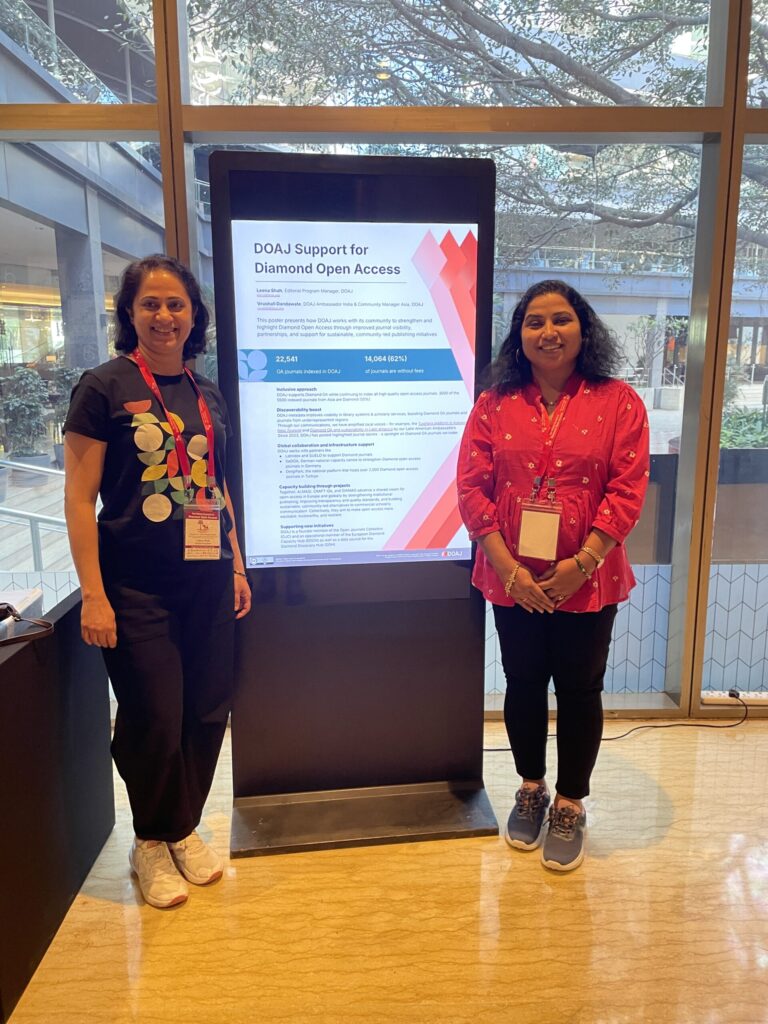
You might have wondered how many people are behind the scenes at DOAJ and what they do. This blog post series will offer our community an opportunity to meet several of our team members and learn more about their roles and responsibilities. In this blog post, we meet Leena Shah, Editorial Programme Manager.
Hello Leena! Tell us a little about your background before joining DOAJ!
My professional career began in Singapore, where I worked as an IT analyst and I was programming in Informix 4GL. I decided to step away from my career for a few years to focus on raising my child full-time. When I was ready to return to the workforce after that extended break, I wanted to find a role focusing on “information.” This led me to pursue a Master’s degree in Information Studies in Singapore, and led to my transition into a second career as an Academic Librarian.
My journey with DOAJ started in 2016 when I relocated to Bengaluru and in the same year DOAJ launched its Ambassador Programme. I joined DOAJ as an Ambassador for India and it was very exciting to advocate and raise awareness of open access and DOAJ back in my home country. In the years following, I took on different roles within DOAJ – I was the Volunteer Coordinator for a few years when I set up the volunteer training and onboarding programme, and broadened our volunteer engagement activities. In addition to that, I was the Managing Editor for India, Indonesia and other regions. I also worked with the Integrity and Ethics Team, which was previously called the Quality Team.
In 2025 I transitioned to my current role as Editorial Programme Manager. The primary areas of my work are to maintain a continuous throughput from the editorial team and to ensure our standards are applied in our internal editorial processes efficiently. I work with Matt Hodgkinson, Head of Editorial and Cenyu Shen, Deputy Head of Editorial (Integrity & Ethics) to provide joint leadership across the Editorial Management Team. By leveraging my experience, I identify opportunities for optimization within the editorial workflow and act as a liaison between the editorial team and platform management. With 23,000 journals indexed in DOAJ (and growing), I manage the editorial team’s re-review of the oldest entries. It is a large task, and our objective is to have all journal metadata in DOAJ reviewed within a two-year cycle. I currently spend most of my time on the Editorial Workflow Project to redesign our current editorial workflow to improve overall efficiency and to provide better feedback and experience to users applying to DOAJ.
I now reside in London in the UK and I am happy that I have been able to continue to work and grow with DOAJ amid all the moves.
Generally, what does your work week look like at DOAJ?
In a typical work week I am frequently switching between my responsibilities. As a virtual team, our regular meetups with team members happen online and a lot of our team engagement happens on our online platforms where I handle day-to-day editorial queries or discussions on other tasks. I monitor the task distribution within the editorial team to balance out any uneven workload due to a sudden surge in applications from a particular region. I recently built extra capacity in our triage team to handle the large volume of applications. What gives me the most satisfaction is to analyse our internal processes and drive changes to minimize errors and optimize performance, such as automating our internal handling for journal updates and the recent change in our journal transfers process to prevent direct transfers to publishers who have not passed through our editorial checks successfully.
Every week I meet with Brendan O’Connell, Platform Manager and our systems vendor, Cottage Labs. I bring editorial domain knowledge to these sessions and we prioritize and address various tasks concerning the editorial system. In addition to that, I am the project lead for the Editorial Workflow Project and these meetings are devoted to discussions related to the project. This is a multi-year project to revamp our editorial system, and move it from a tiered user hierarchy to a model where the application progress is tied directly to its compliance with DOAJ standards. The new system will gather red flags at different stages to aid the Integrity and Ethics investigations. We are currently working on building the initial layers of this project and releasing the triage module soon.
Occasionally, I am also involved in joint initiatives with other organisations where I provide editorial expertise and oversight.
And I suspect your IT background, too, would be really helpful in this space?
Absolutely! This comes in very handy when I liaise between editorial and our system vendors who maintain our editorial system. Drawing on my IT background, I convert editorial needs into clear functional specifications that are easily understood by developers. Combined with my subject matter expertise in editorial standards and processes I am able to initiate and drive changes to improve the editorial system and provide a better experience for the team.
In terms of scholarly publishing internationally, what do you think are the priorities now for DOAJ?
DOAJ has a strategic plan and we are mindful that we have over 23,000 journals in our index. To me, that’s a valuable asset we have built in the last two decades and one of our priorities is to make sure these journals continue to comply with industry standards and our records reflect accurate journal metadata for the scholarly community to discover.
Over the years, we have seen a rising trend in the number of applications we receive. While many of them simply do not comply with our standards, the challenge is to filter out applications that may seem to “comply” with our standards but indicate questionable publishing behaviour. To filter out such applications we have not only added but increased the number of checks for red flags pointing to questionable behaviour. These checks are implemented early and at every stage in our workflow.
Our editorial team has also grown in the last few years and our priority now is to overhaul our in-house editorial system to sustain this increasing workload. With the Editorial Workflow Project we are going to deploy a system which can handle the continuous growth, and the complexities of our processes. This includes a seamless integration of our Integrity and Ethics checks. The new system will allow the Editorial Team to make use of a system guided recommendation to facilitate decision-making and we will be able to provide a better quality of feedback to our applicants as well. In addition to this we are also working on providing feedback to applicants and offer a pre-assessment service that informs them of the areas they need to work on before they submit an application to us.
With that in mind Leena – what is the most challenging part of the job, and what do you enjoy most?
With this variety of responsibilities it is challenging when I need to focus on a specific task that needs a dedicated amount of time. Working online on a time-bound group project is challenging with different time zones and availability of members.
What I enjoy most is the opportunity to connect and converse with colleagues from across the globe—both virtually and in person—as well as the wonderful sense of camaraderie that defines our team.
I feel proud that I play a small part in the work that DOAJ does to encourage and bring journals and publishers across all countries and languages together into one shared conduit from which all journal metadata further flows downstream into different discovery systems around the world. When we index the first journal from a particular country or language – that brings a big smile to my face!
Our conversations about open access have changed compared to a few decades ago. What are your views on open access?
The debates around open access have changed since I was a librarian back in 2012 when the topic was Green versus Gold open access models and routes. Back then as an academic librarian we were in a rush to submit faculty publications into the open repositories to achieve green open access. Other conversations around research assessment and equitable access have since progressed from building awareness to focusing on action to achieve it – publishing preprints, read and publish agreements, hybrid open access, Diamond open access and others.
I believe the world is big enough for different open access publishing models to co-exist for the simple reason that as long as publishing research is a profitable business it will continue to exist in one form or the other. We might never reach a time where we all use one truly equitable non-profit publishing model to make research accessible. However, to argue with my previous statement, I would place my bets on Diamond open access which is free-to-read and free-to-publish and is poised for growth. I am very inspired by a recent event I attended (the 3rd Global Summit on Diamond Open Access) which put out a call for action asking the community to take up responsibility, and address issues surrounding sustainability and funding of open infrastructure supporting diamond open access.