DOAJ provides a unique, openly available set of journal metadata that supports the global research community. As Dominic Mitchell and Katrine Sundsbø note, its strength lies in its community-driven approach and relies on publishers, editors, and users maintaining accuracy by updating records or reporting errors.
Without journal metadata, DOAJ wouldn’t be anything. Without publishers applying to be indexed, we wouldn’t have journal metadata. Our journal metadata is original, unique to DOAJ and open to all. It is a vital component of many discovery systems around the world. We need publishers to keep it up to date.
Since the very beginning of DOAJ in 2003, the Directory has not only been the home of open access journals but also of the metadata for each and every one of them. The journal metadata we collect has changed over time, from very simple information such as ISSN and when the journal started publishing, to include detailed information such as copyright, APCs, licensing, peer review time and more. The metadata we collect has become extremely valuable to the scholarly community – frequently consulted for teaching, research or funding decisions on APCs, to name a few. In 2025, we decided to upload annual records of our journal metadata to Zenodo – snapshots in time that our community can use. Our index and metadata is likely to continue to develop in line with community needs, and while we do a lot of work to maintain the index, we rely on publishers, editors and journal managers to keep their metadata up to date.
Where would we be without publishers, editors and journal managers?
From 2003 until 2012, we used to email editors to let them know that their journal had been suggested for inclusion in DOAJ and ask them to please complete a full application. We even allowed others to submit an application on behalf of a journal, which sometimes resulted in journals being indexed in DOAJ without either the publisher or the editor knowing.
Back in 2015, when DOAJ embarked on its “reapplication project”, we emailed all the journal contacts in DOAJ, telling them that if they wanted to remain indexed, they needed to complete a reapplication form by a specified deadline. We then sent them reminders. On one occasion, an angry editor wrote to us telling us that he wasn’t going to comply with any of our requests because he had no idea why his journal was indexed with us and his journal didn’t need DOAJ anyway. At his request, we removed his journal from the Directory. In a way, he was right: his journal was hosted on a prestigious Ivy League university platform and by all accounts, he was inundated with submissions. DOAJ was still transforming from a list of peer-reviewed open access journals to a globally recognised service with a standard of quality within open access publishing. And our new application form, with its 54 questions and criteria, was daunting to say the least. Still, 60% of all the journals we indexed successfully reapplied and the rest is history…
On one level, the reapplication project was a massive editorial and administrative undertaking, both for the DOAJ editorial team and for the editorial staff at each journal or publisher. For the first time ever, we asked them to collect more than 50 data points on how their journal strove to meet research ethics principles, maintain high levels of integrity, and apply rigorous editorial standards. On another level, the reapplication project was the starting point of the declaration and accumulation of this unique set of publishing standards and best practices that today includes the metadata from over 23,000 journals and is downloaded from our platform by commercial and non-commercial organisations and private individuals the world over.
And none of that metadata would be possible without our publishing communities.
The value of original open access journal metadata
Our journal metadata is a tiny part of a huge and open metadata ecosystem; open metadata that flows from the publishers into DOAJ and out again into library portals, research centres, countless websites, discovery tools, AI-assisted products and much more; metadata that is then used in workplaces, for research, product development, global health, climate change, and more. Maintaining and updating that journal metadata may not always be a particularly enjoyable task but it’s a crucial step in maintaining a metadata system built on community and trust.
If you have journals indexed in DOAJ and are of any doubt as to why your journal metadata matters, look at the work done by bibliometricians, researchers and librarians that are monitoring and plotting the growth of open access. Mikael Laakso published a guest post on our blog about the value he finds in DOAJ metadata. Both he and Jan Erik Frantsvåg used DOAJ journal metadata to write and publish the OA Diamond Study, which is the precursor to a series of EU projects.
How do we continue to maintain and develop our metadata?
We keep our metadata current through a combination of publisher input and community feedback. We encourage publishers to submit updates via their publisher dashboards and annually, send our largest multijournal accounts files so they can update all their journals at the same time. We also receive open tickets from some of our largest discovery service partners, which we either fix ourselves or forward to the journal publisher. We also respond to feedback we get from our community through our Help Desk or Feedback widget. Our users might have found a problem and request an update to a journal, which we then fix ourselves or forward to the journal publisher.
We also engage with funders and consortia to monitor trends and developments in open access publishing, to understand how to continue to develop the metadata we collect. Earlier this year we announced the inclusion of four new columns to our metadata; Subscribe to Open, Mirror Journal, Open Journals Collective and Last Full Review Date.
How can you help maintain and update journal metadata in DOAJ?
If you are a publisher, journal manager or editor and you have access to your DOAJ account, you can submit update requests after you log into DOAJ. It is important to do this whenever anything changes, be that the APC amount, the homepage URL or one of your policies, for example. Each request will be reviewed by our team before the information is updated in the index. There are some things that you can’t update in which case, it’s better if you contact our Help Desk.
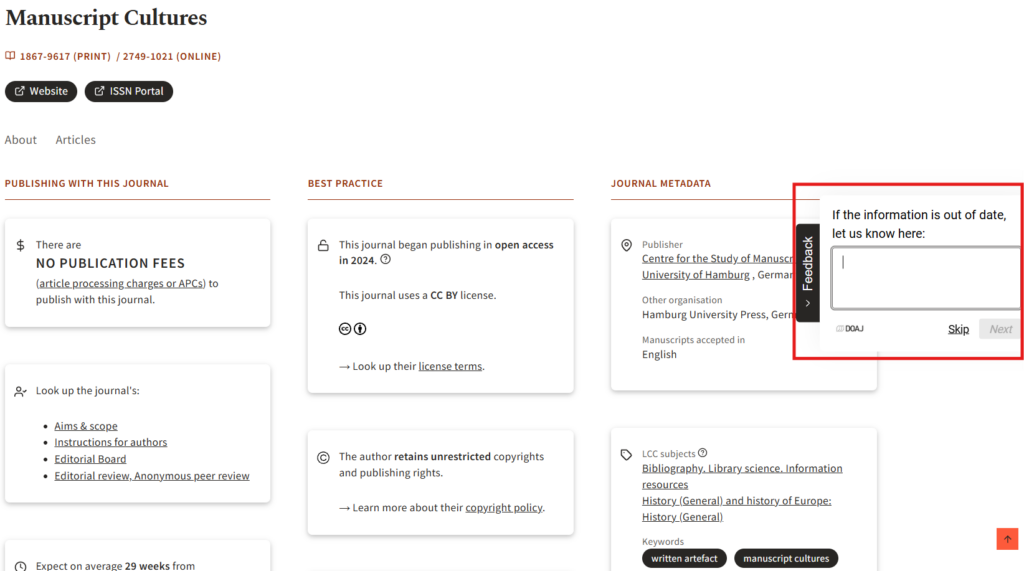
If you don’t have access to your DOAJ account or are a part of the wider community, and notice any information that is out of date, please use the small black Feedback widget on the right side of the screen of each journal entry. Give us details about the information that is incorrect or missing, and we will review and update the information.
You have probably noticed that our metadata is a very large dataset. We now have over 23,000 unique journal records. Keeping all the records up to date is a huge challenge, as the scholarly publishing environment changes all the time, and journals adapt too. DOAJ is a community-led organisation to its core. Maintaining this large dataset is only possible due to the work done by the DOAJ team and our community of publishers, journal managers, editors, researchers, funders and librarians. Thank you so much for helping us maintain these records so that they can continue to provide key insights to the open access publishing environment and drive strategy and decision-making worldwide.
Dominic Mitchell is Deputy Director, and Katrine Sundsbø is Head of Community and Communications at Le DOAJ