
DOAJ Community Manager and Ambassador for Asia, Vrushali Dandawate attended the recent Global Summit on Diamond Open Access. She shares her reflections on an event that gathered librarians, publishers, researchers, and policymakers from around the world, all committed to creating a more open, fair, and sustainable system for sharing scholarly knowledge.
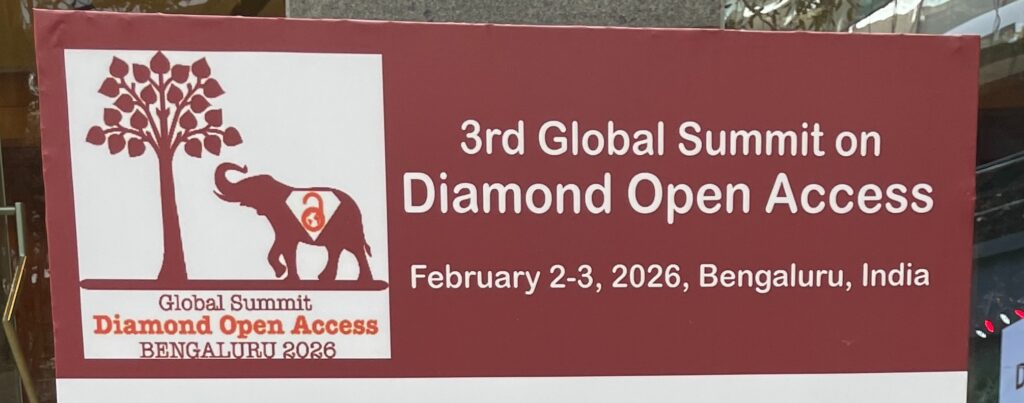
I recently had the opportunity to participate in the 3rd Global Summit on Diamond Open Access held in Bengaluru, India (2-6 February, 2026). It was a very enriching experience for me as a librarian and also as DOAJ Community Manager and Ambassador for Asia. The Summit brought together librarians, publishers, researchers, policymakers, and open access advocates from across the world who are working towards making scholarly communication more open, equitable, and sustainable.
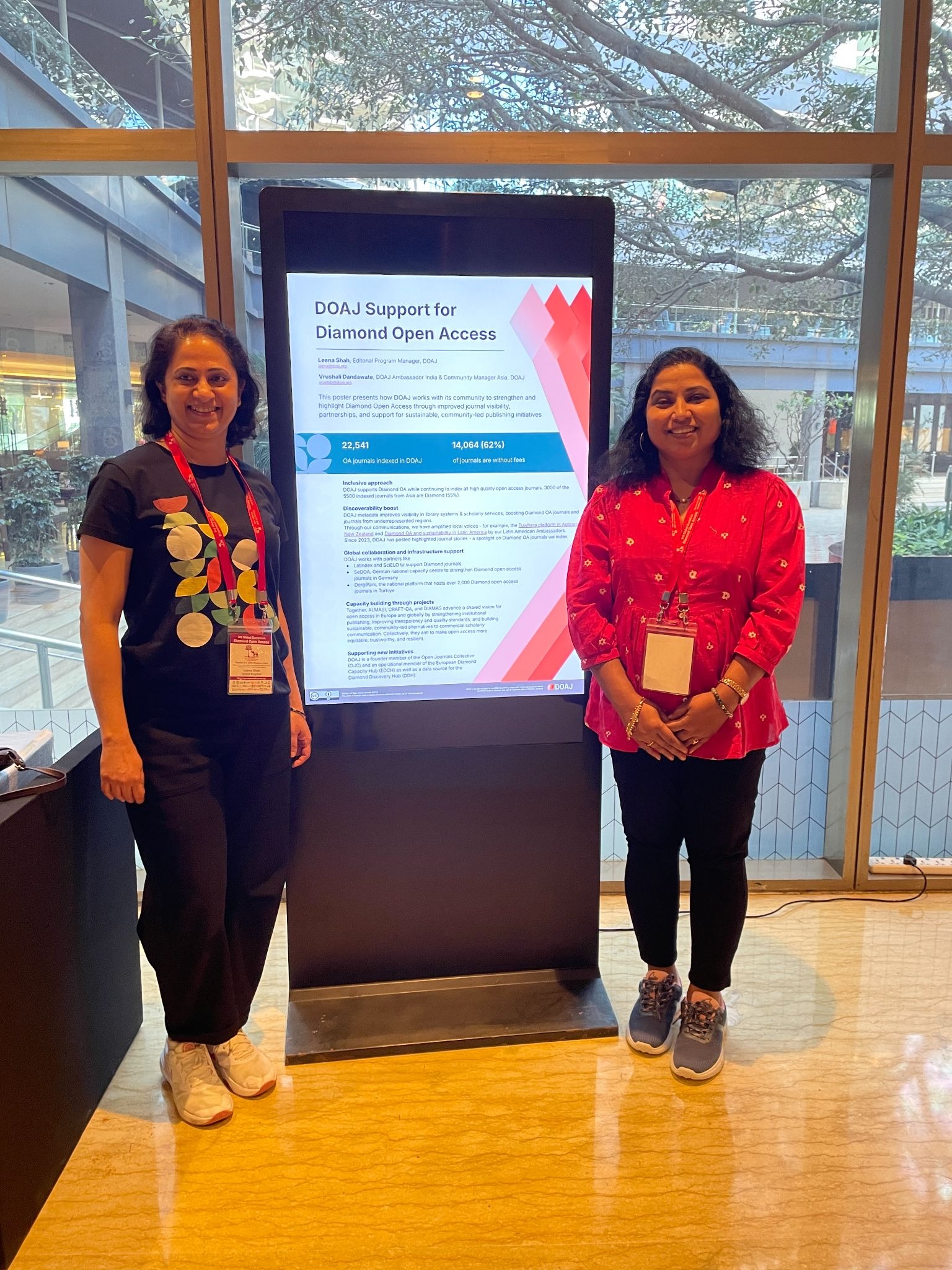
During the Summit, I had the privilege of presenting a digital poster on “DOAJ Support for Diamond Open Access” jointly with my DOAJ colleague Leena Shah (Editorial Program Manager). This poster showcased DOAJ’s focus on Diamond open access, its role in improving journal visibility and quality, and its collaboration with global initiatives such as DIAMAS, ALMASI and the Open Journals Collective to promote equitable and sustainable scholarly publishing.
The Summit highlighted the important role of Diamond open access journals in providing free access to knowledge without charging authors or readers. This model is especially significant for India, where many scholarly journals already follow the Diamond model but often face challenges related to visibility, technical infrastructure, and sustainability. Sessions focused on improving journal quality, metadata standards, indexing, and global visibility through platforms such as DOAJ and other open science tools and publishing platforms.
One of the key discussions during the summit was on the Bengaluru Roadmap, which aims to provide practical recommendations for strengthening Diamond open access globally. For India, this roadmap offers an important opportunity to align institutional and national policies with global open access initiatives and to build stronger support systems for community-led journals.
The Summit program was particularly useful for the Indian academic and library community. It provided practical ideas on how institutions and libraries can support Diamond journals, improve editorial standards, and promote multilingual and regional language research. The discussions emphasised that knowledge should reach society in local languages and not remain limited to English alone.
Another important takeaway was the need for more collaboration. The Summit created opportunities for Indian librarians, editors, and researchers to connect with global experts and with each other. The first day of the Summit was dedicated to workshops, and plenary sessions and thematic streams in the following days allowed for questions and discussions. From my own perspective, there is a strong need for Indian institutions to work together, share resources, and collectively support Diamond journals through policy support, funding, and capacity-building initiatives.
Overall, the Summit was highly motivating for the Indian community. It reinforced that Diamond open access is not just a publishing model but a movement towards inclusive and equitable knowledge sharing. Heartiest congratulations to Mr. Sridhar Gutam and the organising team for successfully hosting such an important global event in India. The experience has inspired me to continue working towards strengthening Diamond open access in India and across Asia, and to promote open knowledge for the benefit of society.
The next Global Summit Diamond Open Access is scheduled to be held in Bali, Indonesia in 2027
Vrushali is the DOAJ Asia Community Manager and Ambassador for India, and Head Librarian at AISSMS College of Engineering, Pune. She holds a Ph.D. from Reva University, Bengaluru, with research on open access e-resources in Asia. She actively promotes open access and scholarly communication across the region and has received international recognition including the ALCTS Online Course Grant (2014), INASP Open Access Week awards (2015, 2016), and participation in OpenCon (Berlin 2017, Toronto 2018). She serves on global advisory and conference committees and hosted the COAR Open Access Asia meeting in India with UNESCO in 2024.

Wonderful to see such thoughtful representation from India at the 3rd Global Summit on Diamond Open Access in Bengaluru. Dr. Vrushali’s reflections beautifully capture the spirit of collaboration, equity, and sustainability that Diamond OA stands for. The focus on strengthening journal quality, metadata, visibility, and multilingual scholarship is especially relevant for the Indian academic ecosystem. Congratulations to Dr. Vrushali, Ms. Leena Shah, and the entire DOAJ team for championing this movement, and kudos to the organisers for hosting such a meaningful global dialogue in India. Looking forward to seeing the Bengaluru Roadmap translate into real impact across institutions.