During 2026, DOAJ celebrates ten years of the Ambassador Programme. In this very special post, Ambassador for Latin America Gimena del Rio Riande reflects on her DOAJ journey.
Looking back to 2020, when I first stepped into my role as one of the Directory of Open Access Journals (DOAJ) Ambassadors for Latin America, I carried with me a passion rooted in my daily academic life. As a researcher at CONICET (Argentina’s National Scientific and Technical Research Council), my work has always been driven by the conviction that knowledge should be a public good, and that open infrastructures must serve to democratize access to research. Joining the DOAJ team opened a vibrant international chapter in my career – one that transformed how I view scholarly publishing, regional diversity, and the power of collaboration.
Over these years, my work has been defined by three guiding pillars: listening deeply to journal editors across Latin America, helping to build strong regional alliances, and fostering open, data-driven approaches to understand the complex realities of our publishing ecosystem.
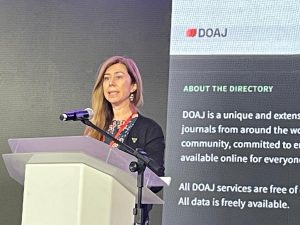
In global scholarly communication discussions, Latin America is frequently held up as a golden standard – a region celebrated worldwide for its pioneer history in Diamond open access, where journals are funded by public universities and research institutes without charging fees to either authors or readers.
While this narrative is true and inspiring, my six years of direct interactions with hundreds of editors have taught me a critical lesson: Latin America’s open access landscape is not a monolith. One often speaks broadly of “Latin American open access,” but the concrete realities, operational budgets, and day-to-day problems change drastically from country to country, university to university, and discipline to discipline. Understanding these subtle distinctions transformed my approach as an ambassador. Rather than imposing rigid, top-down assumptions about what open access should look like, I realized that my primary responsibility was to listen to editors.
In my role as DOAJ Ambassador, I have sought to act not as a gatekeeper, but as a bridge. Editors in Latin America are extraordinarily dedicated individuals. Many work with limited budgets, balancing their editorial duties alongside teaching, research, and administrative loads.
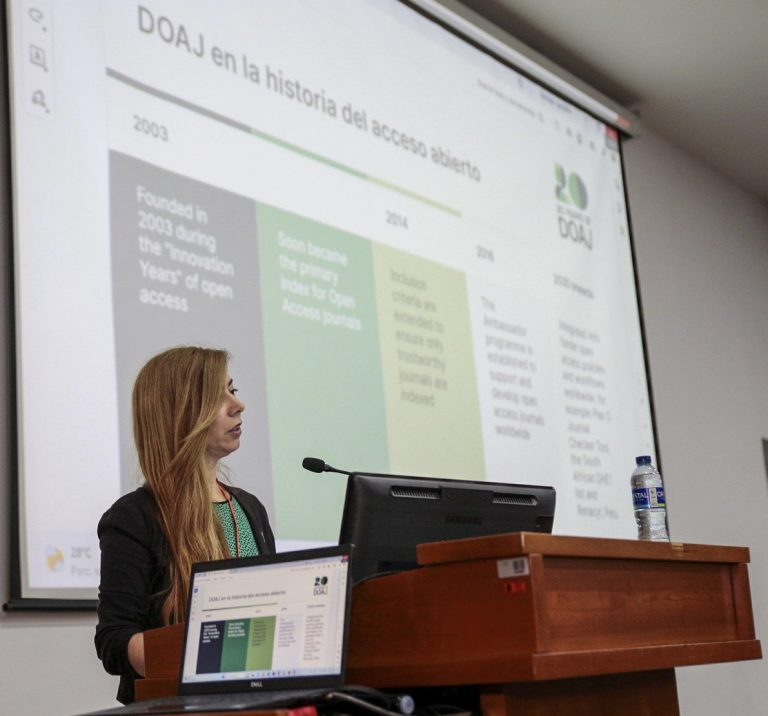
Universidad de Antioquia, Colombia. 2023
My strategy for supporting these editors centers on practical, empathetic accompaniment. Over the past years, I have organized and led dozens of targeted, hands-on workshops and webinars designed to demystify the DOAJ application process. Beyond formal events, keeping in touch with editors requires sustained, accessible communication. Whether responding to specific emails regarding copyright clauses, advising on how to display archiving policies, or explaining the importance of machine-readable metadata, every conversation is an opportunity to strengthen an editor’s confidence.
One of the most significant milestones of my ambassadorship has been fostering and participating in the formal DOAJ-Latindex Partnership. Latindex has been a cornerstone of scholarly publishing quality in Latin America, the Caribbean, Spain, and Portugal for decades. Bringing DOAJ and Latindex into a structured, collaborative framework allowed us to join forces on two critical fronts these days in our region: editorial quality criteria and questionable publishing practices.
Reflecting on these years fills me with gratitude and confirms that no journey in open access is walked alone. From my very first days as ambassador, working with DOAJ has meant becoming part of a supportive, generative global family. My journey has been inextricably linked with Ivonne Lujano, DOAJ Senior Ambassador and Community Manager. Together, we have spent years co-designing roadmaps, writing articles, delivering webinars, advising editors, and representing DOAJ across academic venues in the region. However, our work in Latin America expanded significantly when Carolina Dias joined our team as Ambassador to Brazil. Brazil represents a massive, vibrant scholarly publishing landscape with unique institutional frameworks and a distinct language context. Carolina brought methodological rigor, energy, and enthusiasm. Together, the three of us formed a cohesive, bilingual Latin American team capable of addressing Spanish- and Portuguese-speaking communities with equal depth and nuance.
The journey continues, and I look forward to everything we will build together in the years to come.
Gimena del Rio Riande, PhD, is Senior Researcher at CONICET (IIBICRIT), Director of HD LAB, Professor at Universidad del Salvador, and DOAJ Ambassador for Latin America. The photos in this post are used with permission.