The Publication Facts Label, an initiative of the Public Knowledge Project (PKP) that has been endorsed by DOAJ, is introduced by open research consultant Alice Meadows.
A strong, robust, and (ideally) open research infrastructure is an essential part of the research ecosystem, supporting every stage of the process from grant application to publication and beyond. But it’s fair to say that access to this infrastructure isn’t always equitably distributed among researchers. Much of it has been developed by and for researchers working in STEM disciplines in the Global North, often leaving those in other disciplines and communities to find their own solutions and workarounds.
There are, however, a number of notable exceptions including, of course, DOAJ itself, which launched in 2003 with 320 fully OA journals, nearly 60% of them in the humanities and social sciences, and all published by small publishers from close to 40 countries. SciELO is another great example of a successful open infrastructure that was built by and for a previously underserved community; in their case, non-English language Latin American publications. A third example – and the topic of this post – is the Public Knowledge Project (PKP), whose Open Journal Systems (OJS) is currently used by more than 58,000 journals in 157 countries.
These grassroots initiatives to support the long tail of smaller, less financially secure journals – often non-English language – are critical for bibliodiversity, for equity, and for helping level the playing field for the valuable knowledge generated by less well-funded and recognized scholars. These organizations also help ensure that the journals themselves can more easily adhere to publication standards, for example, by encouraging or requiring the use of Digital Object Identifiers (DOIs) for articles and ORCIDs for authors; or by sharing best practices, for example, through DOAJ’s involvement in the Think, Check, Submit. initiative. This adherence can, in turn, help legitimize these journals which are, otherwise, often considered low-quality or even predatory.
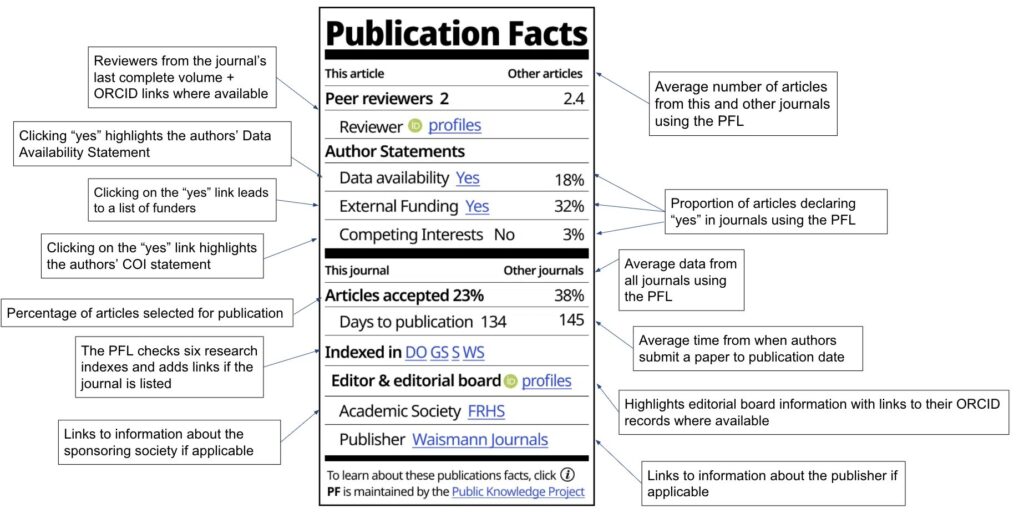
PKP is now going a step further to help address the integrity and transparency challenges faced by the entire industry – from journals in the long tail to those published by big commercial publishers – with the introduction of the Publication Facts Label (PFL). Modeled on the widely-used Nutrition Facts label, its goal is to quickly and easily share facts about a research article with whoever is reading it, whether that’s another researcher, a journalist, a policy-maker, a member of the public, or anyone else. The label appears as a dropdown on the article landing page and, rather than providing a value judgement on the content of the article, instead it delivers facts about the article’s adherence to well-established scholarly publishing standards. This includes things like the number of reviewers, the time to publication, whether there are any conflicts of interest or datasets connected with the article, and more (see Figure 1). All the data in the label is pulled directly from the publishing system, which helps to guarantee its validity, and raises the bar on preventing hacking.
The Nutrition Facts label is something we all take for granted but, in fact, it’s only been around for about 30 years – the first version was introduced in 1994 in the US and versions of it have subsequently been launched in numerous other countries. According to this 2025 USDA study, the US version is now regularly used by nearly 80% of adults over the age of 18 – a pretty impressive takeup!
While the PFL is unlikely to become a government requirement like the Nutrition Facts label, PKP hopes that it will, in time, become a standard, not just for journals using OJS, but across all scholarly journals. The ultimate goal is for it to mimic the success of the Nutrition Facts label, helping to improve trust in the research by increasing transparency about the publishing process in a way that can be easily understood by all readers. To help ensure this level of accessibility, the PFL was road-tested on over 100 researchers, science journalists, … and high school students! The latter proved tough but invaluable critics during the development process, but there’s still more work to be done to get them fully on board. PKP included a brief feedback poll in their recent pilot of the label with 130 OJS journals and, while members of the public (22% of those who opened the label) scored it 4.8/5 in terms of usefulness, and researchers scored it 4.4, high schoolers (admittedly a small sample size) graded it 2/5. Perhaps more importantly, in a 2024 Nature poll, 72% of the 3,783 readers who responded gave it a thumbs up, as did 99% of the 72 attendees at the 2024 OASPA conference.
The PFL is currently being rolled out to the 42,000 journals using recent versions of OJS, and has already been adopted by well over 500. As you know, many of these journals are also indexed in DOAJ, which has had a close relationship with PKP since its launch. So we very much appreciate Matt Hodgkinson’s recent endorsement of the label on behalf of DOAJ:
DOAJ welcomes the launch of the Publication Facts Label, to present information about the article and journal in a standardized, structured way, especially the verification of the peer review process by the OJS back-end. We are planning to test whether the PFL is useful for our assessment of journals applying for indexing.
And we’re delighted to be talking to DOAJ about the value of the label, especially in terms of increasing transparency about the publication process. Watch this space for updates as these conversations continue – and watch this video for a quick and fun overview of the Publication Facts Label!
My thanks to John Willinsky of PKP for reviewing this post.
Alice Meadows is an independent consultant, who specializes in — and supports the values of — open research. She frequently collaborates with Open Research Ecosystem Consulting and was previously a co-founder of the MoreBrains Cooperative. Alice’s career has spanned both scholarly publishing (at Blackwell Publishing and then Wiley) and research infrastructures — first as Director of Community Engagement & Support of ORCID, and then in a similar role at NISO (National Information Standards Organization). Alice is actively involved in the scholarly communications community, including serving as President of the Society for Scholarly Publishing (SSP) in 2021-22 and regularly contributing to their Scholarly Kitchen blog. She is passionate about the need for a robust and open global research infrastructure, and about improving diversity, equity, inclusion, and accessibility – in scholarly communications and in society at large.
Bluesky: @alicemeadows.bsky.social | LinkedIn: www.linkedin.com/in/alice-meadows