
The Open Climate Campaign’s work on open access to climate research is being sustained by DOAJ’s new “open climate campaign” tagging, which creates an easily discoverable subject collection of over 7,000 relevant articles to make climate knowledge more accessible to all.
The Open Climate Campaign
To solve the world’s greatest problems, knowledge about them must be open. This was the impetus for the Open Climate Campaign, a partnership between Creative Commons, SPARC and EIFL with funding from the Arcadia Fund. Initial data collected by the Campaign suggested that only half of the research papers assessed as climate change papers were openly available. This meant that if you were looking for information, be it a model or data for a recommendation on climate change, and you were not part of an institution with a subscription, the chances of accessing that knowledge came down to a coin toss. Advocating for the open sharing of research in climate science, the Campaign ran from 2022-2024 and expanded open access policy, advocated, and pursued various approaches to unbind locked climate research.
While the Campaign wound down in 2024, there have been lasting initiatives to increase access to climate research. For example, Creative Commons continues to facilitate the opening and sharing of climate research via its Open Science work, and this includes datasets and data models. For the past two years, Creative Commons has been working with some of the world’s largest data providers to openly license climate change data and provide metadata recommendations to facilitate interoperability and sharing:
Collectively addressing climate change means that this climate data must be open, accessible, and easy to use, so more people everywhere can contribute collectively to solutions.
Open Climate https://creativecommons.org/about/open-science/open-climate/
DOAJ and open climate tagging
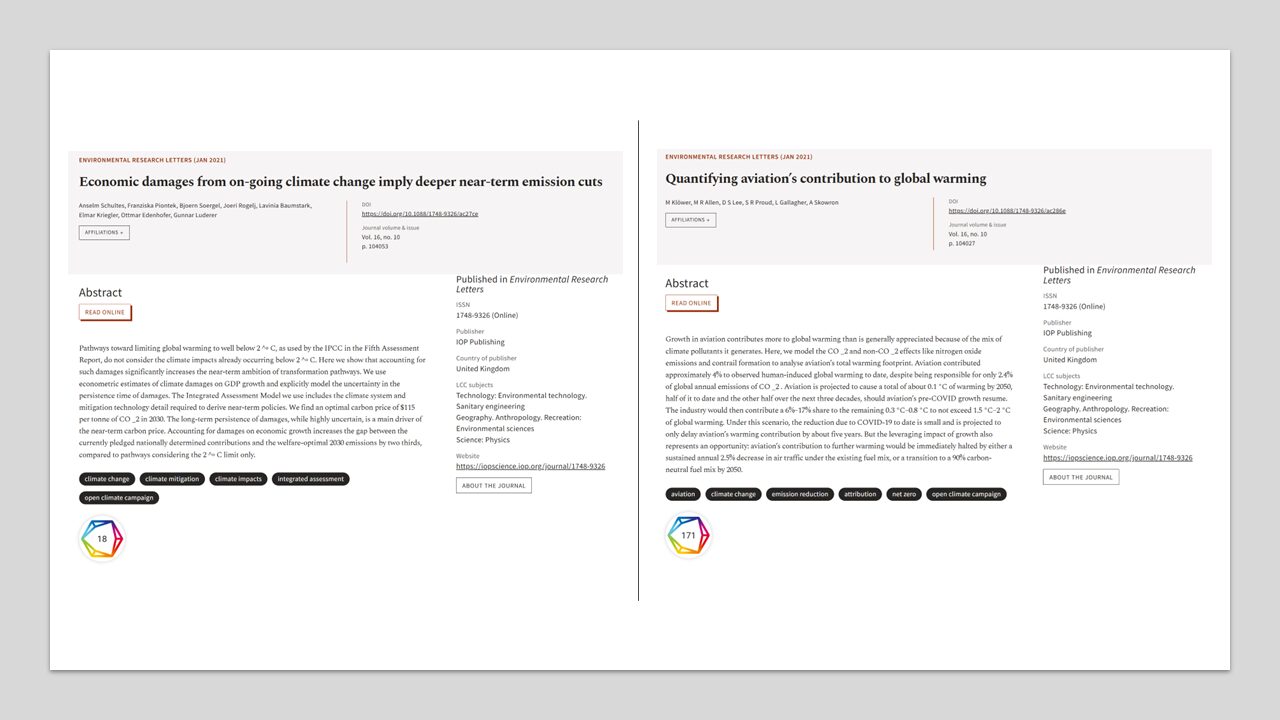
Recently, DOAJ has begun automatically tagging articles highlighted by the sunsetted Open Climate Campaign. In an article search, using the article keywords “open climate campaign” will locate more than 7,000 articles (as of February 2026).

This enables DOAJ to highlight these articles as a subject collection on our website. Deputy Director Dominic Mitchell adds:
“We have more than 11.8 million articles in DOAJ and apart from our search and browse features, we’ve never had a way to create “subject collections” and highlight a subset of them in a way that is impactful for our community of users. When we got the initial spreadsheet from Creative Commons, it was a way for us to very quickly pull all these articles together and give them the visibility they deserve.”
The importance of uncovering climate knowledge
By leveraging the article search, DOAJ is making it easier for those searching for climate change research to access information regardless of institutional affiliation. “This is one of the many ways DOAJ, Creative Commons and other organizations working on open access can position existing tools and infrastructure to increase the impact of interventions and make knowledge more accessible,” says Monica Granados, Creative Commons’ Director of Open Science.
EIFL Open Access Programme Manager Iryna Kuchma has noted how critical access to climate research has become adding, “The climate is changing because we are not. Climate change is real and every step matters in mitigating irreversible impacts, such as ice-sheet collapse and major sea-level rise. I applaud DOAJ for their efforts to uncover open climate change research and calling everyone to reflect on their actions to increase openness.” Iryna also outlines easy steps to make this research accessible: “Publish climate and biodiversity research in open access journals; deposit in repositories and provide open access; make data, code and models open; develop and implement open science policies; create open educational resources and find ways to contribute.”
Climate communication ultimately expands our understanding and awareness of climate change and libraries and library associations around the world are also actively involved in supporting the dissemination of climate research. IFLA Policy and Advocacy Manager Claire McGuire explains:
“The impact of climate change does not recognise borders. This is a challenge that affects everyone – everywhere – and requires bold solutions that fit local contexts while being informed by a global knowledge commons. IFLA strongly believes that comprehensive open access to scholarly literature and research documentation is vital for enhancing our understanding of the world, reducing information inequality, and strengthening our ability to solve global challenges. Initiatives, such as DOAJ’s open climate tagging, can help ensure open climate change research is as impactful as possible.”
How to add or update metadata
So, how can publishers indexed in DOAJ add to or update their metadata to improve the discoverability of climate research?
Well, there are two ways: either when the article metadata is supplied to us, or retrospectively.
If you’re sending us new articles that are about climate change research, you can simply add the tag “open climate campaign” in the keywords field of the XML, JSON or metadata input form. For examples, have a look at any of these articles.
If you want to retrospectively tag articles that are already uploaded to DOAJ, you can resupply them with the keyword added.