
DOAJ plays a crucial role in increasing global visibility for Latin American scholarly journals, most of which follow the Diamond open access model and are funded by public universities and research institutions. In this post, DOAJ Ambassadors Carolina Dias, Gimena del Río Riande and Ivonne Lujano Vilchis note that while the Diamond model remains dominant, a small but growing number of journals in the region are adopting APC-based models to cover operational costs, signaling shifts in the scientific communication landscape and the need for sustainable funding.
DOAJ is a comprehensive catalogue of Latin American OA journals
Currently, DOAJ indexes 3,240 journals by Latin American institutions from 22 different countries. More than 86% of these journals are published by universities, educational institutions, and research centers. The number of Latin American journals in the directory increased by almost 10% between 2020 and 2024, from 2,951 to 3,240 (Crawford, 2024).
DOAJ is especially important for Latin America because it provides global visibility for the journals published in the region. Recent research suggests that being in DOAJ is crucial for being included in OA indexes such as OpenAlex (Chavarro et al., 2025). This is particularly important for the Latin American scholarly publishing system, which has historically differed from dominant models in the Global North (Babini, 2011; Cetto, 2015). In Latin America scholars have developed a strong academic publishing culture embedded in public universities, different from the corporate model dominant in the Global North. Consequently, universities have become major producers of scholarly journals and books. Nowadays, most Latin American journals are funded and sustained by universities or research centers through the Diamond OA model. DOAJ helps these journals that often struggle with international recognition due to language barriers (del Rio Riande & Lujano Vilchis, 2024), limited indexing in commercial databases, and a lack of visibility outside national or regional metapublishing networks (DOAJ, 2023). Together with Latindex Catálogo 2.0, which indexes 3,925 journals from the region, DOAJ is an extraordinary source of visibility for Latin American journals.
The growth of the APC-based model in Latin America
OA encompasses several access models, often labeled as Gold (APC-based OA with open licenses), Diamond (non-fee OA journals with open licenses), and Bronze (non-fee OA with no open licenses) (Piwowar et al., 2018). As an extensive and diverse index, DOAJ welcomes Diamond and Gold OA models while recommending best editorial practices to enhance the visibility, accessibility, reputation, use, and impact of quality research. For instance, recently, DOAJ introduced its first journal label for journals that have transitioned from closed to open access under the Subscribe to Open model (S2O model).
Reports like the 2021 “OA Diamond Journals Study,” commissioned by cOAlition S and Science Europe, cite Latin America as a leading example of sustainable Diamond OA publishing, with strong infrastructures, thousands of journals, and decades of experience (Bosman et al., 2021).
While the scientific journal ecosystem in Latin America is predominantly composed of Diamond OA titles, the number of publications charging APCs appears to have grown in the region (Alperin, 2022; Córdoba González, 2024 ). As of December 2025, DOAJ lists 3,337 journals from Latin American institutions. A mere 4.8% of them, or 166 journals, charge APCs. A recent study at SciELO Chile found that of the 136 journals indexed, only 19 (14%) charge a fee to authors. These amounts vary widely, from USD35 to USD2,690, while 42% are published by scientific or professional associations and belong to Biological Sciences.
Looking more closely at this pool of DOAJ-listed Latin American journals with APCs, the numbers show that medical and agriculture journals lead the APC-based model in the region, with one or the other being more prominent in specific countries, such as medicine in Brazil and Chile, and agriculture in Mexico, Argentina, Peru, and Bolivia. The prevalence of the APC-based model among medical journals is a trend that other datasets have already revealed across regions. For instance, the tool Journal Comparison Service, a discontinued initiative developed by cOAlition S, showed that out of 1,871 journals registered in this service, almost 30% were medical and health science’ journals.
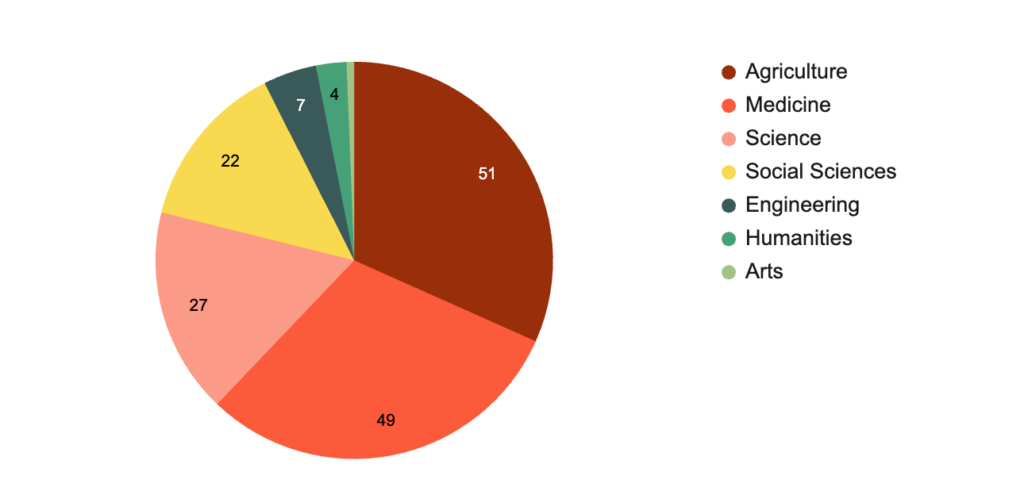
The growing number of OA journals in Latin America with APCs signals changes in the region’s scientific communication landscape. These changes have also affected the methodology of the Latindex Catalog 2.0, which now includes a statement on any fees charged to authors. Furthermore, the APC-based journals or those published by private institutions must be indexed in DOAJ in order to be part of the Catálogo (Latindex, 2025).
A Latin American APC-based model?
There are numerous reasons behind the increasing number of APC-based OA journals in Latin America. These amount to the institutional context, the science and technology structure – often public in the region – and the current policies for scientific communication in these countries. However, a look into the websites of APC-charging journals may help understand some of them.
Interestingly, some Gold OA journals in Latin America include in their editorial/submission policies the reasons for charging authors fees. They often list the items covered by those fees, such as handling costs associated with submission and editing processes, translation, web maintenance, and DOI payments, among others. Such transparency regarding the coverage of their editorial cost structure comes as no surprise, as many Latin American publishers are actually non-profit and/or public universities, educational and research institutions. Their reasons for charging APCs highlight the challenges they face in sustaining the technical infrastructure needed for OA publishing, with author fees often supplementing their primary funding from sponsoring institutions.
In other words, in Latin America, many publishers seem to rely on APCs as a supplementary income stream rather than a source of profit, which contrasts with the role of author fees in commercial publishers’ business models, as many studies have noted. However, most Latin American journals indexed in DOAJ in 2025 are Diamond journals (95% of 3,337). A significant share of Diamond journals is not exclusive to DOAJ, but rather a regional pattern, as this model is prevalent in the region (Alperin, 2022; Beigel, 2025; Beigel et al., 2024 ).
The Diamond OA model remains predominant in the Latin American scholarly publishing ecosystem. However, the growing number of non-profit publishers charging APCs underscores a crucial need for sustainable public and institutional funding to safeguard the long-term viability and accessibility of OA journals in the region.
References
Alperin, J. P. (2022, October 12). Why I think ending article-processing charges will save open access. Nature https://doi.org/10.1038/d41586-022-03201-w
Babini, D. (2011). Acceso abierto a la producción científica de América Latina y el Caribe. Identificación de principales instituciones para estrategias de integración regional. Revista Iberoamericana de Ciencia, Tecnología y Sociedad CTS, 6(17), 1-24. http://eprints.rclis.org/15574/1/babini_EDITADO_FINAL.pdf
Beigel, F. (2025). The transformative relation between publishers and editors: Research quality and academic autonomy at stake. Quantitative Science Studies, 6, 154–170. https://doi.org/10.1162/qss_a_00343
Beigel, F., Packer, A.. Gallardo, O., & Salatino, M. (2024). OLIVA: The Scientific output in journals edited in Latin America. disciplinary diversity, institutional collaboration, and multilingualism in SciELO and Redalyc (1995-2018). Dados, 67. https://doi.org/10.1590/dados.2024.67.1.307x
Bosman, J., Frantsvåg, J. E., Kramer, B., Langlais, P. C. &, Proudman, V. (2021). The OA Diamond Journals Study. Part 1: Findings. Science Europe; cOAlition S. https://doi.org/10.5281/zenodo.4558704
Cetto, A. M. (2015). Las revistas científicas en América Latina y el acceso abierto (AA). Conferencia impartida en el Seminario regional ICTP-UNACH-UNESCO
Córdoba González, S. (2024). Cobrar por publicar (APC) en América Latina: situación de las revistas en el 2023. Discursos del sur [online], 13, 87-106. http://dx.doi.org/https://doi.org/10.15381/dds.n13.28656
Espacio I+D Innovación más Desarrollo, 4(7), 9-30. http://dx.doi.org/10.31644/IMASD.7.2015.a01
Chavarro, D., Alperin, J. P., & Willinsky, J. (2025). On the open road to universal indexing: OpenAlex and Open Journal Systems. Quantitative Science Studies. Advance online publication. https://doi.org/10.1162/qss.a.17
Crawford, W. (2024). Gold Open Access 2024. Dataset. Figshare. https://doi.org/10.6084/m9.figshare.25892869.v1
del Rio Riande, G., Lujano Vilchis, I. (2024). How balanced is multilingualism in scholarly journals? A global analysis using the Directory of Open Access Journals (DOAJ) database. The Journal of Electronic Publishing, 27(1). https://doi.org/10.3998/jep.6448
DOAJ. (2023, March 9). A PLACE for scholarly publishers. DOAJ Blog. https://blog.doaj.org/2023/03/09/a-place-for-scholarly-publishers/
Latindex. (2025). Metodología del Catálogo 2.0. Características de calidad del catálogo 2.0 (Metodología). Versión 8, 18 de junio. https://latindex.org/latindex/postulacion/postulacionCatalogo#:~:text=Las%20revistas%20editadas,tipo%20de%20cargo
Piwowar. H., Priem, J., Larivière, V., Alperin, J. P., Matthias, L., Norlander, B., Farley, A., West, J., Haustein, S. (2018). The state of OA: A large-scale analysis of the prevalence and impact of Open Access articles. PeerJ, 6:e4375. https://doi.org/10.7717/peerj.4375
Scielo. (2023). Declaración sobre el uso de Contribuciones al Costeo de Publicaciones (CCPs) en la Red SciELO. São Paulo, 14 de septiembre. https://25.scielo.org/wp-content/uploads/2023/09/4-Marilin-Declaracion-sobre-el-uso-de-Contribuciones-al-Costeo-de-Publicaciones-CCPs-en-la-Red-SciELO_es.pdf