
Have you tried B!SON yet? It is a simple tool that points authors to relevant open access journals based on a few pieces of information about their manuscript. How it works and how it interacts with DOAJ is explained in this guest post by Anita Eppelin e Marco Tullney.
B!SON is a tool that recommends open access journals based on a particular manuscript, while providing full transparency on what its recommendations are based on. By supporting and simplifying the journal selection process, B!SON supports authors in all career stages who are looking for the best-fitting open access journal. In addition, it can help academic libraries provide guidance to their researchers with identifying the best place to share their research results, even offering an option to use an institutionally adapted B!SON version. B!SON’s algorithm is based on machine learning and uses open data sources, including article and journal metadata from DOAJ. B!SON, just like DOAJ, can therefore be seen as a building block of the open scholarly infrastructure ecosystem.
How B!SON’s recommendation system works
B!SON is very simple to use: key parts of the manuscript—title, abstract, and references—are entered into the input form. B!SON processes the input and returns a list of fitting open access journals, ordered by a score indicating whether the journal has published articles that address the same or similar research topics as the input manuscript.
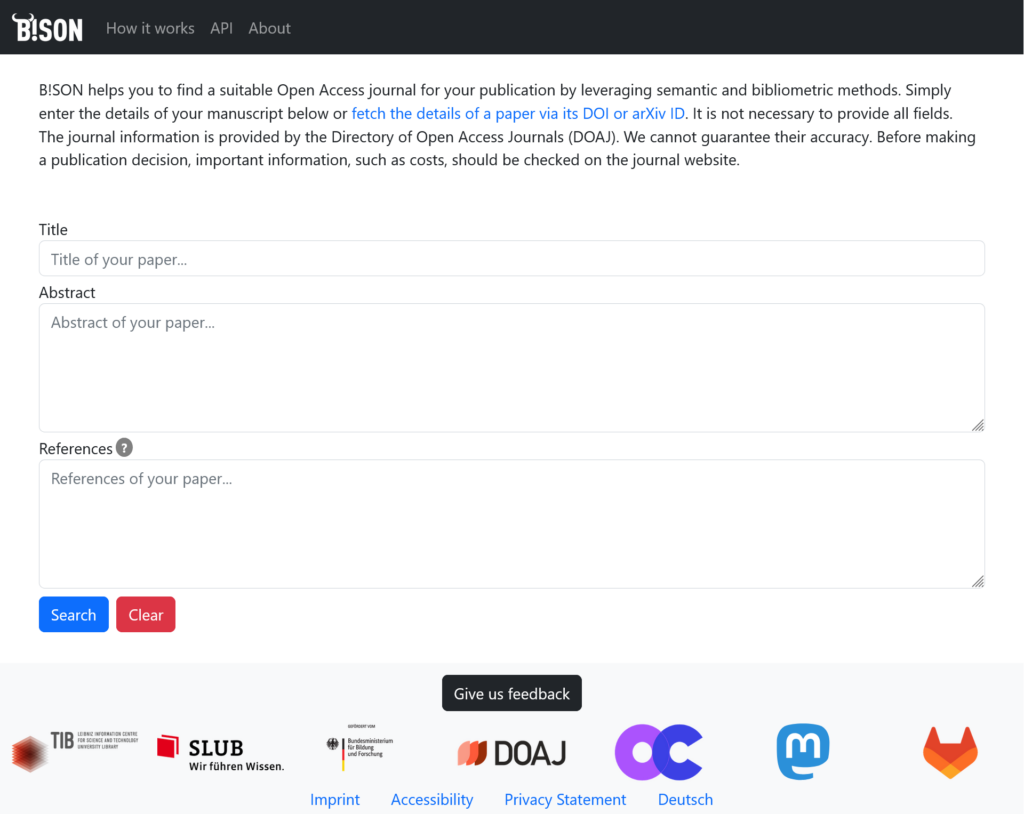
Behind the scenes, B!SON’s algorithm analyses article metadata and citation patterns to generate journal recommendations semantically and bibliometrically. More precisely, semantic and bibliometric similarities between the manuscript information entered and articles that have appeared in DOAJ-listed journals are evaluated. First, title and abstract are compared with the corpus of previously published open access works (via DOAJ’s article metadata) to detect semantic similarities. Second, for the bibliometric component, the article’s references are compared with a citation database, OpenCitations Meta. These two factors are normalised and combined by a neural network to create an overall similarity score that B!SON reports for each recommended journal.
As a result of the analyses, B!SON provides a list of recommended journals that can be filtered, sorted, and exported. For each journal, the score mentioned above, together with explanations (links to identified similar articles that B!SON has found) are given. This provides for valuable background information that allows users to understand the recommendation process and, potentially, also to further explore the similarities. A details page is available for each journal with the most important facts, largely taken from DOAJ’s journal metadata.
Data sources are updated monthly ensuring that B!SON’s algorithm always goes back to the current literature. For a more in-depth description of the structure and algorithm of the system, we recommend this article.
DOAJ and B!SON: A partnership for the benefit of the scholarly community
At the heart of B!SON’s recommendation process is article metadata provided openly by DOAJ as a trusted source for information about open access journals.This connection strives to promote diversity in terms of journal selection by researchers: B!SON’s algorithm gives smaller and younger journals the same chance as broadly known journals and those provided by major publishers so that B!SON’s recommendations are publisher-neutral.
DOAJ’s data is provided by the journals and publishers, who are responsible for keeping the metadata up to date. However, not all journals or publishers upload their full article metadata to DOAJ, limiting B!SON’s ability to find similarities between the user’s input and previously published articles via DOAJ’s data – a step that is essential to find suitable journals. It is important to note, however, that the Initiative for Open Abstracts and the Initiative for Open Citations are doing significant work to improve the overall availability of this data. In other cases, we have come across the occasional error in article metadata and journal information. There is an ongoing exchange between B!SON’s and DOAJ’s teams to resolve such issues if they become apparent through the use of B!SON.
Openness principles of B!SON
B!SON has been developed by Technische Informationsbibliothek (TIB) and Saxonian State and University Library Dresden, both long-time DOAJ supporters . In doing so, we closely adhere to the Principles for Open Scientific Infrastructures (POSI), just as DOAJ does.The commitment to openness comprises not only the focus on open access journals and providing transparency on the algorithm and the similarities behind each recommendation on a functional level, but is reflected also in its data structure and operation. Only open data sources, like those from DOAJ and OpenCitations Meta, are being used, and B!SON itself is provided as Free and Open Source Software, allowing for scrutiny, improvement, and reuse by the community. After the initial development, TIB, as B!SON’s hosting institution, ensures the long-term maintenance and development of the service.
Integrating B!SON with local services for OA publishing
B!SON’s open API enables self-contained integration of the recommendation system into various websites and services. In addition, TIB offers to set up individual B!SON versions for academic institutions to supplement libraries’ advisory services for open access and publishing. For each recommended journal, additional information on local funding conditions is provided. Thus, in the same place where users can discover open access journals relevant to them, they are directed to further support and advice at their local library. Libraries can benefit from this offer without any technical intervention or maintenance work on their part.
B!SON, as a user-friendly and data-driven tool, offers orientation in the wide range of open access journals. With its foundation on DOAJ data, commitment to openness, privacy friendliness and adaptability for institutional use, B!SON can help improve the efficiency and accessibility of open scholarly communication. If you would like to learn more and, eventually, become part of the herd, the B!SON team would be happy to hear from you! bison@tib.eu
An explanatory video on B!SON is also available at https://av.tib.eu/media/62604

Anita Eppelin (https://orcid.org/0000-0003-3184-5930) is working on the topic of Diamond Open Access at Technische Informationsbibliothek (TIB). She began her work at TIB as project coordinator for the initial B!SON development project.
Marco Tullney (https://orcid.org/0000-0002-5111-2788) is head of publishing services at Technische Informationsbibliothek (TIB). He has also been active for many years as an associate editor for DOAJ.