We have added new metadata to our journal CSV, journal TOC pages, search results and API that you need to know about, especially if you integrate our metadata into any of your systems.
The new metadata is best explained by looking at our Journal CSV. In the sections below, the column name (for example “Column AR”) maps exactly to the columns in our journal CSV file. We have added four new columns:
Column AR: ‘Subscribe to Open’
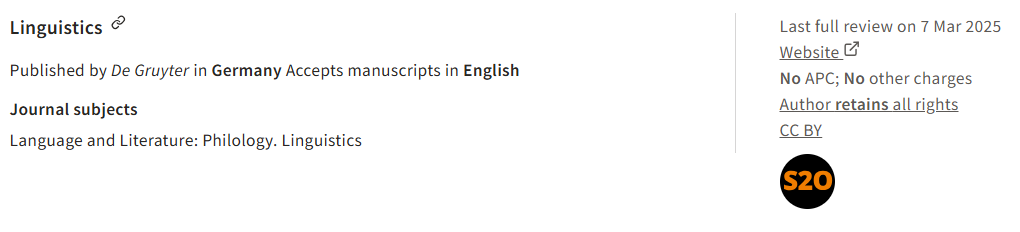
This was added back in March 2025 and was the first of several planned labels. This column indicates whether or not the journal uses the Subscribe to Open (S2O) business model. The information comes from a list of journals we hold at DOAJ. The information appears in the CSV, the API, on a journal’s individual page in DOAJ and in search results (see screenshot below).
Column AS: ‘Mirror Journal’
Added on 18th December 2025 and indicates whether or not a journal uses the ‘mirror journal’ model that, at one point in time, was popular with Elsevier publishing in particular, although it is not limited to this publisher’s journals. This information comes from an internal list held by DOAJ. The information appears in the journal CSV only.
Column AT: ‘Open Journals Collective’
Added on 18th December 2025 and indicates whether or not a journal can be found in the Open Journals Collective (OJC) collection. This information comes from a list of journals provided to DOAJ by OJC. The information appears in the journal CSV only.
ColumnAX: ‘Last Full Review Date’
Added on 15th January 2026 and indicates the last time every metadata point in the journal record was reviewed by one of our Managing Editors. The information appears at the bottom of a journal’s individual entry in DOAJ, in search results, in the CSV and in the API. The purpose of this field is to better indicate the recency of an entire record, rather than the ‘Updated’ date, which changes if only one metadata point is edited in a journal’s record. For example: a publisher may update a journal’s APC but nothing else. In this case, only the ‘Updated’ date will change. If a Managing Editor reviews the entire record at the same time, both the ‘Updated’ and the ‘Last Full Review’ dates will change.
‘Last Full Review’ versus ‘Updated’
Moving forward, we believe that the ‘Last Full Review’ date will be more useful to the community as an indication of a record’s recency than the ‘Updated’ date. Currently, both appear alongside the ‘Date added’ on the bottom a journal’s DOAJ entry (screenshot below):

Later in the year, we will consider removing the ‘Updated’ date from the journal pages but will retain it in our metadata endpoints.
If you have any questions about any of these additions, please don’t hesitate to leave a response here or contact us.