
Martina Dvořáková, editor at Masaryk University Press, introduces the OJS Diamond plugins, a set of free, open-source tools from the CRAFT-OA project designed to significantly improve the visibility and discoverability of Diamond journals. The shining star of the set is the DISCO plugin (Discoverability Companion), which acts as a checklist to help journal editors easily navigate and meet the diverse requirements of scholarly databases and aggregators.
As readers of the DOAJ Blog, you are certainly familiar with the concept of Diamond open access – DOAJ even declared 2025 a “Diamond Year.” In this guest post, I would like to introduce one of the outcomes of the CRAFT-OA project that can significantly improve the visibility and discoverability of Diamond OA journals: OJS Diamond plugins.
Why these tools matter
If you are a journal editor – or know one – you will likely agree that editors in the Diamond OA ecosystem already have a lot on their plates. Many combine editorial work with roles as researchers, educators, students, or research support professionals. As a result, journal publishing often takes place alongside research, teaching, peer review, and administrative duties, leaving limited time and resources to keep up with the growing complexity of scholarly publishing, especially when it comes to visibility, indexing, and metadata quality.
This is precisely where CRAFT-OA comes in. The project was designed to support journal editors in multiple ways: through knowledge resources (such as the Publisher’s Living Handbook for Diamond Open Access and the Guide to Scholarly Indexes), technical tools (including OJS core enhancements and the OpenAIRE Publisher Dashboard), and services aimed at visibility and promotion (such as the Diamond Discovery Hub and OJS Diamond plugins).
All of these tools are public and free to use. If they can help your journal, please make use of them.
OJS Diamond plugins
Most of the OJS Diamond plugins were developed by Radek Gomola, an experienced developer and active member of the PKP community. Radek also maintains one of the largest OJS installations in Europe, MUNI Journals, which currently hosts 48 journals. This hands-on experience gives him a first-hand insight into the everyday needs – and unspoken wishes – of journal editors, whom he supports on a daily basis.
There are six OJS Diamond plugins, but one of them shines brighter than the others: The DISCO plugin. Let’s take a closer look at it, followed by a brief overview of the remaining tools.
The DISCO plugin: Discoverability Companion
The Discoverability Companion (DISCO) is designed as an inventory of requirements set by scholarly databases, indexes, and aggregators. Building on the Guide to Scholarly Indexes, DISCO consolidates these requirements into a single, structured overview. Many databases require very similar criteria but describe them using different terminology. This can make the application process confusing and time-consuming for editors. DISCO addresses this problem by translating diverse requirements into a unified framework that is easy to understand and navigate.
The plugin functions both as a checklist and as a motivational tool: by visually showing editors which criteria they already meet and highlights how close their journal is to being eligible for specific databases.
So, how does it work? We compiled the requirements of the most important academic databases and organised them into categories such as: Diamond criteria, Journal description, Metadata requirements, Journal policies and others. In addition, the plugin includes general recommendations, impact recommendations, and SEO recommendations.
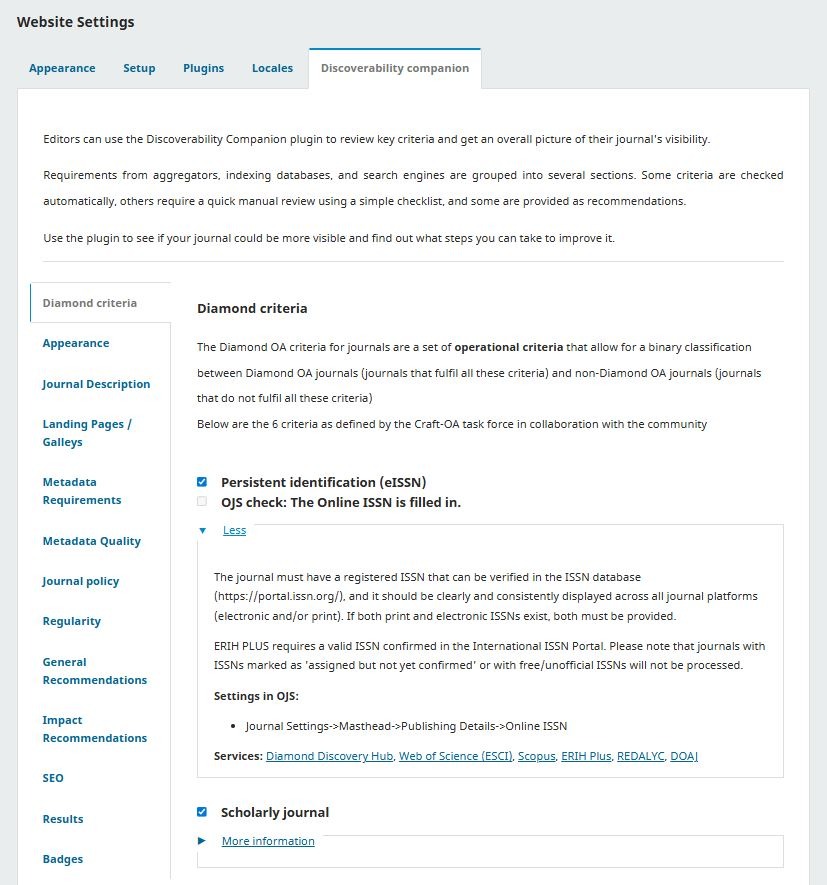
This is what the plugin looks like once installed in OJS (Figure 1). In the left panel, you can see the different categories of requirements, while the central panel displays information for the Diamond criteria category—checkboxes with explanations of what each criterion means and which services require it.
For each requirement, DISCO provides a clear description and indicates which services or databases expect it. In the OJS interface, you will see checkboxes next to individual requirements. Some of them are checked automatically by the system – for example, DISCO can verify whether your journal has a description or whether it publishes issues regularly. Other criteria require editorial input, such as whether the journal is academic-led or whether the editorial board represents multiple institutions.
Once all relevant boxes are checked, the plugin immediately shows which databases or aggregators your journal is ready to apply to, as well as which requirements still need to be addressed for others. When your journal meets the criteria of a particular service, a direct link appears, guiding you to the relevant website where you can apply or find further information.
The DISCO plugin also includes a set of badges – visual icons that highlight key strengths of your journal. When enabled, these badges appear on your journal’s homepage and signal to visitors that your journal is, for example, Diamond OA, community-owned, DOI-assigning, or regularly published. These visual cues can help attract new authors, reviewers, and readers by clearly communicating your journal’s values and quality standards.
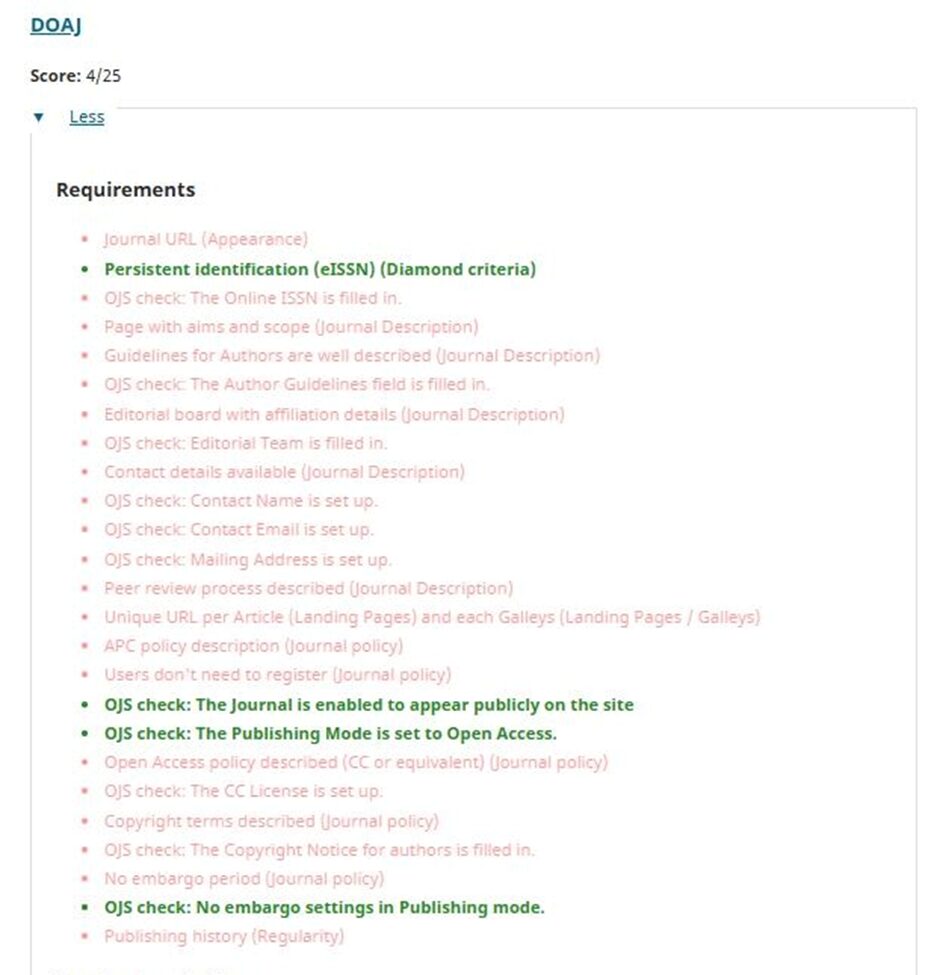
Here you can see how the test journal scored against the DOAJ criteria (Figure 2). Once your real journal has all green indicators, a button will appear at the top and will guide you to the application form on the DOAJ website.
Other Diamond plugins: Interoperability boosters
Alongside DISCO, the CRAFT-OA project has produced several additional plugins that enhance interoperability, metadata quality, and visibility:
Automatically provides your journal’s metadata to the OpenAIRE Graph, one of the world’s largest research knowledge graphs and an authoritative data source for the European Open Science Cloud (EOSC).
Enriches your journal metadata with suggestions provided by the OpenAIRE Broker API via the OpenAIRE Provide service.
- OJS Plugins for the EOSC Interoperability Framework on Research Product Publishing
Based on recommendations from the EOSC Future Working Group, this set includes the SWORD v3.0 plugin, the Signposting plugin, and the Standard OpenAIRE Guidelines for Literature Repository Managers v4 plugin.
Improve interoperability between publishing platforms by enabling seamless conversion between JATS and TEI XML formats. These plugins were developed by Dulip Withanage and Jean-Christophe Souplet.
Provides an easy way to harvest journal metadata in JMEF, a generic and open format currently used primarily by the Diamond Discovery Hub.
Ready to try them?
Pretty cool, right? These plugins can handle much of the technical work for you. Even better, they are all open source and ready to use: simply download, install, and start exploring their features. You can also adapt them to better suit your local needs or build entirely new solutions on top of them.
So please follow the provided links, experiment with the plugins, and discover how they can help your Diamond OA journal become more visible, discoverable, and sustainable.
Disclaimer: As a non-native English speaker, I used ChatGPT while writing this blog post to help improve my language and to express my ideas clearly and concisely. However, the final text is my own, and I take full responsibility for it as the author.

Martina Dvořáková is an editor at Masaryk University Press and a Diamond Open Access ambassador in the Czech Republic. She was involved in the EU-funded CRAFT-OA project and serves as Secretary to the Board of the Association of European University Presses (AEUP), where she supports collaboration and knowledge sharing among European university publishers.

Radek Gomola is an IT editor and programmer at Masaryk University Press, responsible for the development and maintenance of the university’s core platforms for electronic publishing – MUNI Journals (journals.muni.cz) and Munispace – the Masaryk University reading room (munispace.muni.cz). Radek is actively involved in the international OJS development community and contributes to the European CRAFT-OA project by developing OJS Diamond plugins.