Revue Congolaise des Sciences et Technologies (Congolese Journal of Science and Technology) is an open access journal based in DRC, published by the Conseil Scientifique National République Démocratique du Congo (CSNRDC). As part of our ‘Story behind the journal’ series, DOAJ spoke with the Editorial Secretary, Georges Christian Mabiala.
Tell us about the journal
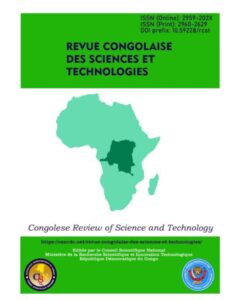
Revue Congolaise des Sciences et Technologies (Congolese Journal of Science and Technology) is a multidisciplinary journal, with the aim to contribute to the sustainable development of humanity in general, and the Democratic Republic of Congo (DRC) in particular. The journal is published by the Ministry of Higher Education, Universities, Scientific Research and Innovation of the Democratic Republic of Congo (formerly Ministry of Scientific Research and Technological Innovation) aimed at local researchers, but we also receive papers from other African countries like Niger, Côte d’Ivoire and Madagascar to name a few. We publish papers in both French and English. The journal started publishing in 2022 as an open access journal, and operates with a low cost APC model. External authors pay $70 to publish, and local authors within the DRC pay $50 to publish. The journal started publishing through a traditional website set up, but now combines with OJS because this is a better platform for publishing. While looking for ways to improve the journal, I discovered OJS, and thought it would help us. We’re still learning this platform, and I would say we’re currently mastering it at 75-80%, and doing our best to get to 100%!
Tell us about your background
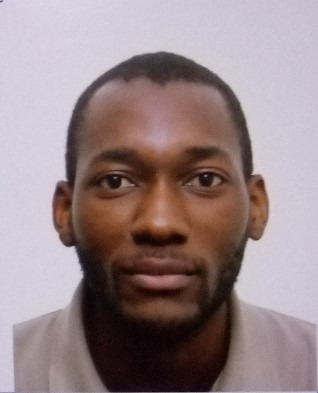
I have a Master’s degree from DRC in Loyola University of Congo (formerly Institut Supérieur Agro-Vétérinaire) where I worked as a teaching and research assistant from 2016 to 2019. I moved to Belgium in 2019 to do a Masters degree in aquatic resources and aquaculture management (Liege University). I then followed the program “University Certificate in Doctoral Project Preparation” in Liege University, but didn’t have anyone to support me in Phd studies. So, I moved back to DRC in 2020 to work at the Geophysical Research Center where I had been working since 2018, and from where I was discovered and invited to join the journal as Editorial Secretary.
What motivates you to be involved with this journal?
Firstly, prestige – it is a journal by the Ministry, so it is very prestigious. I did a presentation at a conference, which was aimed at helping researchers improve their skills. After the presentation I was approached by the Editor-in-Chief, and he asked me to join the journal team to work with them to set up the journal. In the beginning, I helped researchers follow author instructions and did copy editing work. Now, my motivation is to learn. Working with the journal, we learn a lot through attending webinars by organisations like AJOL, EIFL and DOAJ. I hope to one day do a PhD, so working in this journal and learning about the research process helps.
What was the process of getting journal to DOAJ
We worked to improve our processes, both in terms of IT and how everything is displayed on the website, as well as the content to make sure everything adheres to DOAJ and other platforms. It was a challenge to learn everything we needed, but there were many good tutorials through OJS. However, a lot of the tutorials and information was in English, which made it challenging to follow as our native language is French.
What are your thoughts on open access?
Open access is a good thing, it facilitates access to knowledge without paying anything to access it. Our journal operates with the APC model, or gold open access, as we need funds to be able to function. As mentioned, this cost is low, and only covers the costs of operating. However, having this cost also means we sometimes lose out on grants and aren’t eligible for support through some schemes, due to the focus on supporting Diamond OA journals.
Why do you think DOAJ is important to the scholarly community?
It is important for eligibility and visibility. Here in the country some universities oblige PhD students to publish in journals displayed on DOAJ.
What could DOAJ do in the future to help journals such as yours?
We need more technical and scientific support (OJS/PKP) – but also grants and financial support. Indeed, on the one hand, the scientific research sector is underfunded in our developing countries, and scientific journals even less so. On the other hand, at the national level, we are among the pioneers of scientific journals worthy of the name internationally. The level we have reached today is the result of sacrifices and working with limited resources. But above all, it’s because we love this work; we are passionate about it. More resources will allow us to work in dignified conditions and propel our journal even further.