The quarterly update to the DOAJ Guide of Applying is introduced by Head of Editorial Matt Hodgkinson, revising our position on shared copyright, announcing a new requirement for Subscribe to Open (S2O) journals, and clarifying some wording.
As we announced in July, all updates to our guide to applying are being released quarterly. For this quarter, version 2.7:
A. Shared copyright
DOAJ did not allow the copyright of articles to be shared between authors and publishers. We said, “Copyright is held by the owner of a work – it cannot be shared” (slide 13 in PUBLIC VERSION Copyright and licensing in open access journals.pptx, February 2022).
However, we realised this wasn’t in our guide to applying, nor our licensing & copyright policy. We want our policies to be transparent. We looked again and found that although shared copyright is not standard, there are no legal or publication ethics reasons to not allow it. We would not recommend using shared copyright, because it can be complicated.
One use of shared copyright could be when a non-commercial license is used: as co-owners, the authors and publisher would each be allowed to use the work commercially and give others that right without needing to ask each other for permission. They would need to share any profits. Gadd et al. (2003) also suggested universities and academics could share copyright ownership.
- We’ve added: “Copyright may also be shared by the author (and their institution) and the publisher, though this can be complicated and we do not recommend it.”
- We’ve tidied other parts of the policy:
- We’ve explained the note that “Even when the author retains copyright, restrictions may sometimes be imposed by the publisher” by adding “DOAJ recommends that publishers do not restrict the rights of the copyright owner in this way”.
- We’ve clarified, “Copyright terms must not contradict the licensing terms or the terms of the open access policy” to say that this means the journal’s or publisher’s open access statement.
- We’ve changed our wording on “fair use” journals, to say “We do not accept free-to-read journals that restrict reuse of their content to “fair use” only, also known as ‘Bronze journals’.
B. Subscribe to Open (S2O)
Subscribe to Open (S2O) is a new model of open access (OA) in which all articles published in a subscription journal in a year are made OA forever if the journal meets its financial goals for that year (generally based on the number of subscribers). The publisher decides each year whether content will be published OA versus closed access/hybrid. DOAJ is a member of the S2O Community of Practice (CoP) and we launched a label for S2O journals indexed in DOAJ in March of this year.

“S2O allows publishers to convert journals from subscriptions to OA, one year at a time. Using S2O, a publisher offers a journal’s current subscribers continued access. If all current subscribers participate in the S2O offer (simply by not opting out), the publisher opens the content covered by that year’s subscription.”
(Source: Subscribe to Open Community)
When S2O was in development, we did not predict that some publishers would delay the decision on OA each year, leaving two-to-three months when the annual content of the journal is not OA. We expected that some publishers would face delays in deciding the OA status, but not routinely or for months. Although these publishers will retrospectively make all the content for the year OA if that is the decision, DOAJ requires that content be immediately OA. We are also concerned about ‘double dipping’: article processing charges might be charged during a hybrid period for articles that would have been OA anyway in under three months.
We discussed this in the editorial and executive teams, and with the CoP, and we consulted our Editorial Policy Advisory Group and independent stakeholders. Based on these discussions, we decided that these delays are not appropriate.
We are updating our additional criteria for S2O journals to specify that “When an S2O year ends, the decision on whether the content will be OA or closed/hybrid for the next year must be decided without interruption. A routine delay in deciding S2O status each year is not acceptable, because DOAJ does not allow delayed/embargoed OA.” We have also clarified that once open, content needs to stay open.
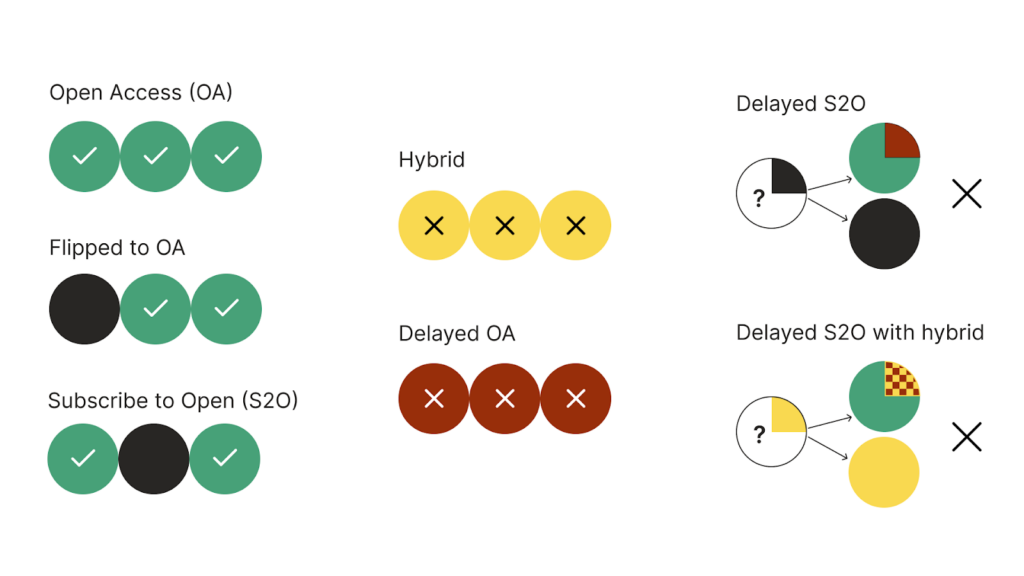
In the Illustration of open access (OA) models and their acceptability to DOAJ (above), each circle represents one year, moving forward in time left to right. Green indicates open access under a Creative Commons license (or compatible). Black represents closed access. Yellow represents hybrid, under which individual articles in a subscription journal are made OA if a charge is paid. Dark red is where there is an embargo or delay before articles are made OA. Dark red and yellow checks shows a mix of delayed OA and hybrid OA. A tick (✅) shows models acceptable to DOAJ, and a cross (❌) shows unacceptable models. A question mark (❓) shows how the model for the journal is unknown until part-way through the year, when a decision is made.
C. Wording changes
As with the Principles of Transparency and Best Practice in Scholarly Publishing, we have used ‘should’ for recommendations and ‘must’ for requirements. This was unsaid, so we have made it explicit:
“In this guide, “must” means a requirement and “should” means a recommendation. “May”, “can”, or “permitted” means something is allowed.”
We have revised some of the wording to clarify what is required, and tidied up some other minor issues.
Thank you to the editorial team, particularly Leena Shah, Deputy Head of Editorial (Workflow), and to the Editorial Policy Advisory Group for their input and help with these updates.