In May 2025, Sámi dieđalaš áigečála (Sámi Scientific Journal) was included in DOAJ and is the only scholarly journal publishing exclusively in Sámi. Editor-in-chief, Harald Gaski provides some information about the journal and the value of supporting and amplifying Indigenous voices.
Sámi people
Sámi dieđalaš áigečála (SDÁ), published by Septentrio Academic Publishing, is to my knowledge the only academic journal in the world exclusively published in an Indigenous language – the Sámi language. The Sámi are the Indigenous people of the northern regions of Norway, Sweden, Finland, and the Kola peninsula in Russia (for more information see the Saami Council https://www.saamicouncil.net/en/home/). The total population is difficult to decide, since the definition of who is Sámi is primarily based on self-identity in addition to some basic criteria for qualifying to be part of the census, which in turn decides voting rights for the Sámi parliaments in Norway, Sweden, and Finland. An estimate is between 50,000 and 100,000 Sámi. The Sámi parliaments have a limited degree of self-determination in cultural and educational matters, but primarily are consultative bodies for the national authorities.
One issue of importance for Sámi educational politics is to support the continued existence of the Sámi languages – of which nine still exist today. The languages have been under threat because of assimilation policies from the nation states. The idea is that Sámi should be able to use their language from pre-school, through primary and secondary education, and through to university, including writing PhD dissertations in Sámi. Several people have already received their doctorates in Sámi language and literature, which currently is the only program in Norway, Sweden, and Finland fulfilling the national criteria for PhD education in Sámi.
Sámi dieđalaš áigečála (SDÁ)
In order to provide a medium for scholarly publications in Sámi, Sámi dieđalaš áigečála (SDÁ) was established as a collaborative project between Sámi allaskuvla (The Sámi University of Applied Sciences) and UiT – The Arctic University in Norway. It is a Diamond open access journal publishing since 1994, and online since 2013. In its early years, the journal mainly published articles within the field with established concepts and terminology in Sámi, i.e., Sámi language and literary studies. During the consolidation period of the journal, the editors began to invite other disciplines to contribute to the building up of Sámi as a scientific language with a broader scope. Thus, Sámi dieđalaš áigečála over the last few years has extended its portfolio to include social sciences, law, and humanities disciplines other than languages and literature, in a trans-disciplinary approach reflecting a holistic view represented in Indigenous cultures.
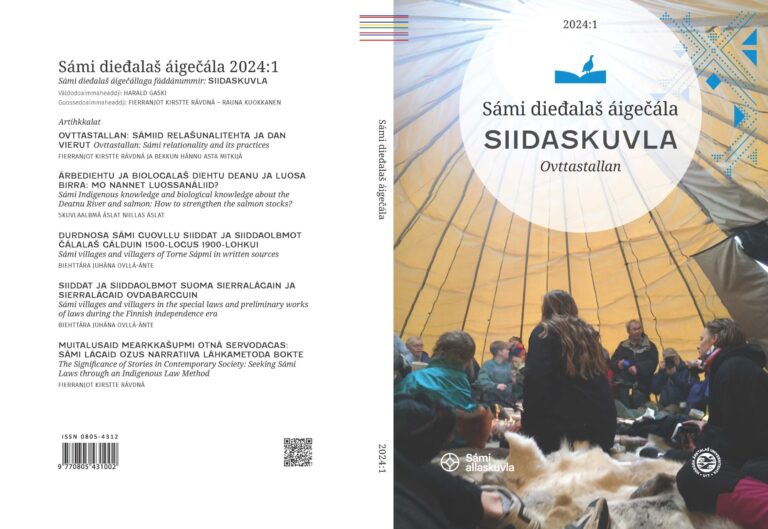
I have been Editor-in-chief for the past five years (2020-2025), and I’m currently in the process of stepping down for retirement. During my editorship, the journal has undergone significant changes regarding how to professionalise SDÁ to meet the requirements and standards for being an open access scientific journal engaged in best practice internationally. SDÁ is now indexed in DOAJ, and as such is hoping for enhanced visibility, even though the readership may continue to be low, given the linguistic limitation of the journal when only publishing articles originally written in Sámi. The keywords and abstracts in English have increased the number of people who visit the journal’s website – an indication of a growing interest in Sámi and Indigenous studies. SDÁ seems to have genuine readers from all over the world, which is an interesting (fun) fact.
SDÁ is open to everyone who writes Sámi well enough at the required academic level, and the journal also provides some resources for contributors who need assistance in finding – or developing – the correct terms and concepts within topics and subjects that are still lacking sufficient professional terminology in Sámi. Thus, SDÁ is an active part of the endeavor to improve and develop the opportunity to write and publish scholarly material in a chosen Sámi language. So far, SDÁ has published articles in three Sámi languages, of which the highest percentage is within North Sámi, which also represents the majority of the Sámi-speaking people (almost 3/4 of the total population).
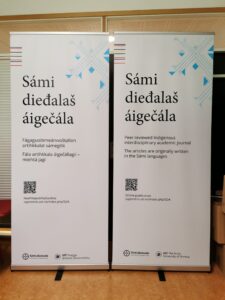
SDÁ has started to publish articles written by PhD students as part of their article-based dissertations. This type of activity demands extra resources from the journal, as the editors and external peer reviewers become additional advisers to the candidate. The editorial team has – at least so far – decided to continue this practice as the opportunities for getting scholarly articles published in Sámi are represented more or less only by SDÁ. In this manner, the Sámi academic community includes new voices and the PhD students and candidates are great ambassadors for the journal. Being a Diamond open access journal also makes it easier for readers all over the world to access the published articles.
DOAJ as an indexer of global knowledge
As Editor-in-chief of Sámi dieđalaš áigečála I am very happy for the journal to be included in DOAJ. It is a great achievement for the journal and it is my contention that it is also something to be proud of for DOAJ to include more Indigenous scholarly journals. Some people may wonder if there is a sufficient critical mass of peer reviewers for a journal like SDÁ, but in my five years as Editor-in-chief I have never had a problem finding well-qualified peer reviewers. There are many researchers who read Sámi excellently, but who still are reluctant to write scholarly articles themselves in Sámi. My mission has been to get these people to submit articles to the journal themselves. To my satisfaction, several of them have volunteered to serve as peer reviewers, which I am very grateful for, as this opens up ever-so-important communication between Indigenous scholars and our non-Indigenous colleagues, who are knowledgeable about what’s going on in the Indigenous research world, and who support it by giving good advice and necessary critical feedback to the article authors.
It is my hope that DOAJ will continue to keep their eyes open to the possibility of including more Indigenous journals into their register, as they have done with SDÁ. I also want to extend my gratitude to the current publisher, Septentrio Academic Publishing, for their support and resilience in convincing the SDÁ editors of the necessity to apply for inclusion in DOAJ, and simultaneously for their strong advocacy with the DOAJ assessment committee for why it is important for academia as a whole to open up for Indigenous partnership in the global venture of advanced scholarly publication opportunities.
The future challenge for SDÁ is to continue to prove its legitimacy to remain in the DOAJ register, which provides international recognition and opportunities for continued fruitful collaboration.

Harald Gaski was born and grew up on the river Deatnu/Tana in Sápmi, Norway. Gaski is an author, editor, and a professor in Sámi literature at Sámi allaskuvla/Sámi University of Applied Sciences in Norway. Prior to his position at Sámi allaskuvla, he served for more than 30 years at UiT – the Arctic University of Norway. Gaski’s research specialises on Sámi culture and literature, both oral and written, Sámi worldview and values, aesthetics and Indigenous critical studies. He was instrumental in establishing Sámi literature as an academic field from the mid 1980s onward. Gaski has translated Sámi literature and Nils-Aslak Valkeapää’s poetry into Norwegian and English. His most recent book is the trilingual Vuoiŋŋalašvuohta – Samisk åndelighet – An Essay on the Sámi People’s Spiritual Connection to Land from 2025. Worth mentioning is also his anthology of Sámi literature, published in 2020, titled Myths, Tales and Poetry from Four Centuries of Sámi Literature. His first book is from 1987, Med ord skal tyvene fordrives, an account and analysis of narrative juoigan (Sámi folk music) texts. Gaski has been a visiting scholar at several universities internationally. He served on the International Research Advisory Panel of New Zealand’s Māori Centre of Research Excellence at Auckland University for 10 years (2006-2015). In 2006 he was the recipient of the The Nordic Sámi Language Prize, Gollegiella, and in 2024 he was awarded an honorary doctorate at Umeå university in Sweden.
DOAJ sincerely thanks Professor Harald Gaski for this post and wishes him a very happy retirement!